The International Atomic Energy Agency (IAEA) held its annual General Conference (GC) from 15 to 19 September 2025. A VCDNP delegation actively participated in the conference and VCDNP experts spoke at two side events.
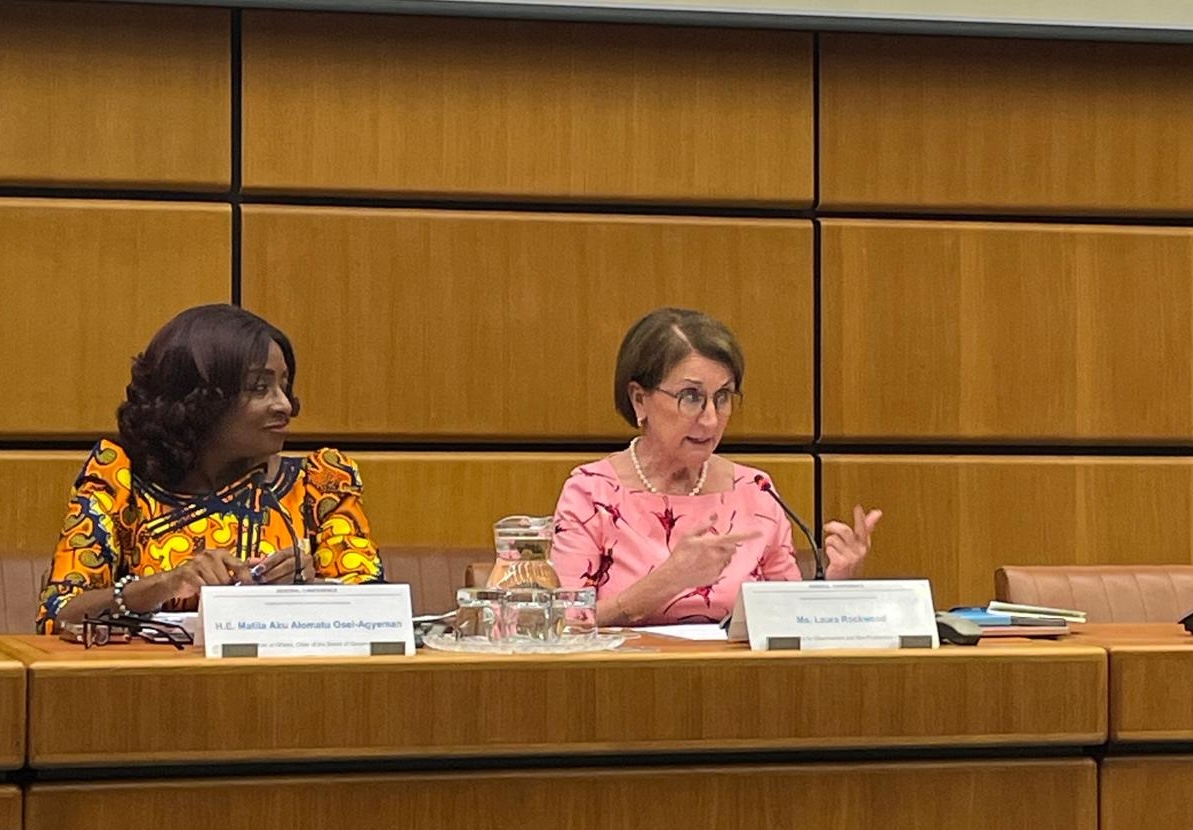
Senior Fellow Laura Rockwood spoke at the event “Facilitating the Early Entry into Force of the IAEA Article VI Amendment”. Ms. Rockwood spoke on an event on the same topic at the 2024 General Conference. In the 2025 General Conference meeting, she reminded delegates of how the composition of the IAEA Board of Governors is determined by Article VI of the Statute, distinguishing between members designated by the Board and those elected by the General Conference. She noted that although the Board has consisted of 35 members since the last amendment entered into force in 1989, this figure is not actually stated in the Statute but must be inferred from its provisions and from practice.
Ms. Rockwood explained how informal understandings among Member States have shaped the way designated seats are allocated in different regions, and how these arrangements had to adapt as the Agency’s membership grew. This led to successive amendments in 1963, 1973, and 1989 to expand the Board. She recalled that further negotiations in the 1990s focused on balancing efficiency with equitable representation, on whether to formalise rotation practices, and on the role of regional groupings. The eventual compromise was the 1999 amendment, which would add eight seats to the Board upon entry into force. For this amendment to enter into force, a consensus list of all Member States, in which each has been included in one of the areas identified in Article VI.A.1, must be approved in the Board of Governors and the General Conference by 90% of Member States present and voting in both.
As the amendment has not yet entered into force and IAEA membership has grown substantially since 1999, she stressed the importance of bringing the amendment into effect to ensure that the Board of Governors continues to reflect the Agency’s expanding membership and operates effectively.
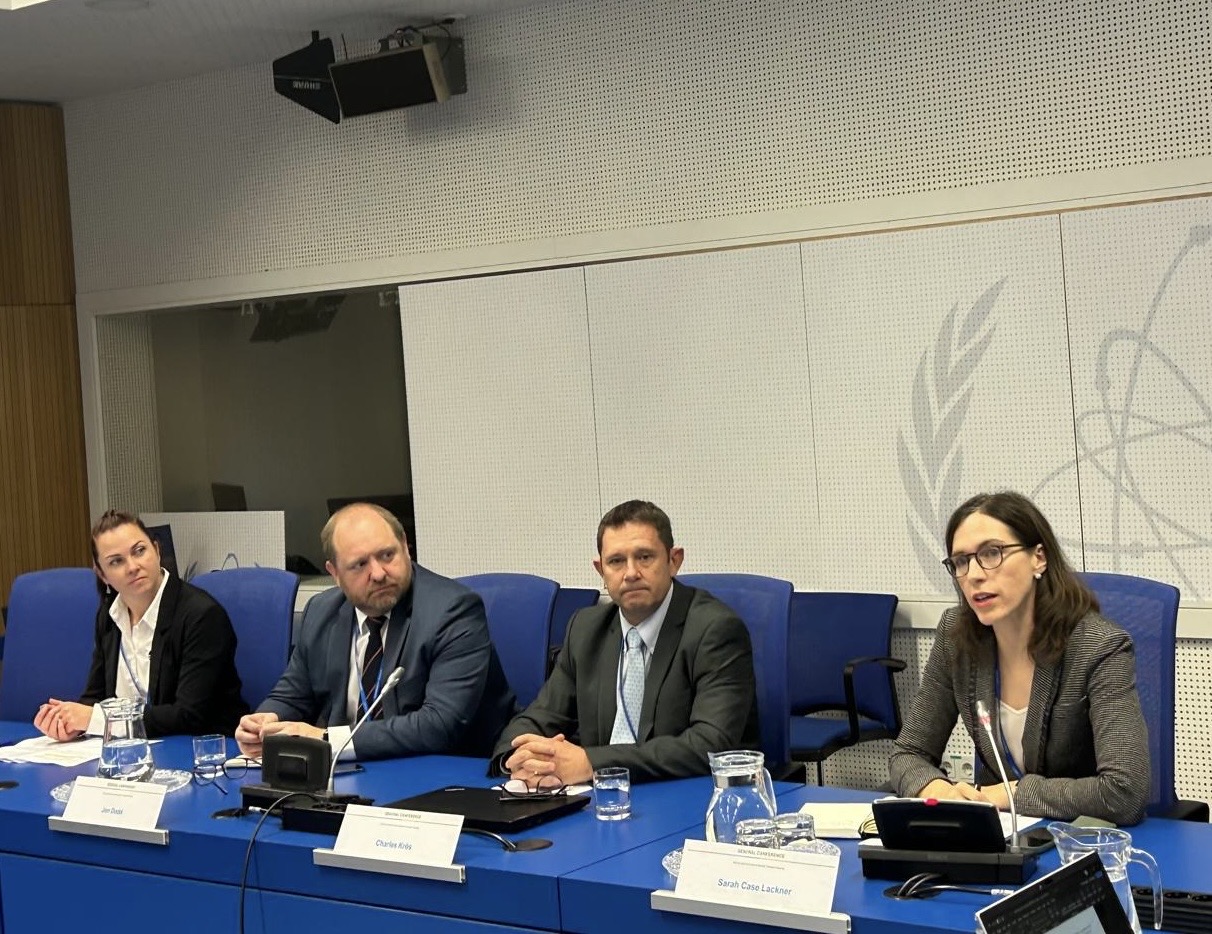
Senior Fellow Dr. Sarah Case-Lackner contributed to the event “HALEU and the Future of Nuclear Transport Security”. Dr. Case-Lackner examined whether existing international frameworks are sufficient to govern the transport of high-assay low-enriched uranium (HALEU). She observed that, while HALEU remains below the 20 percent enrichment threshold and is therefore classified as low-enriched uranium, higher enrichment levels and larger shipment quantities can raise security requirements, potentially moving shipments into Category II protection with associated cost implications.
She emphasised that the Convention on the Physical Protection of Nuclear Material (CPPNM) and its Amendment, together with IAEA guidance documents and the International Maritime Dangerous Goods Code, already provide the necessary legal and regulatory basis.
At the same time, she pointed out that universal adherence to the CPPNM Amendment is still lacking, including among some flag States (the country to which a ship is registered), complicating efforts to criminalise and prosecute nuclear-related offences. Dr. Case-Lackner also underscored the need for consistent and robust implementation of international transport guidance, greater use of training and assistance, and the value of international and regional cooperation, such as that promoted under INFCIRC/909, to strengthen coordination and preparedness for cross-border shipments.