




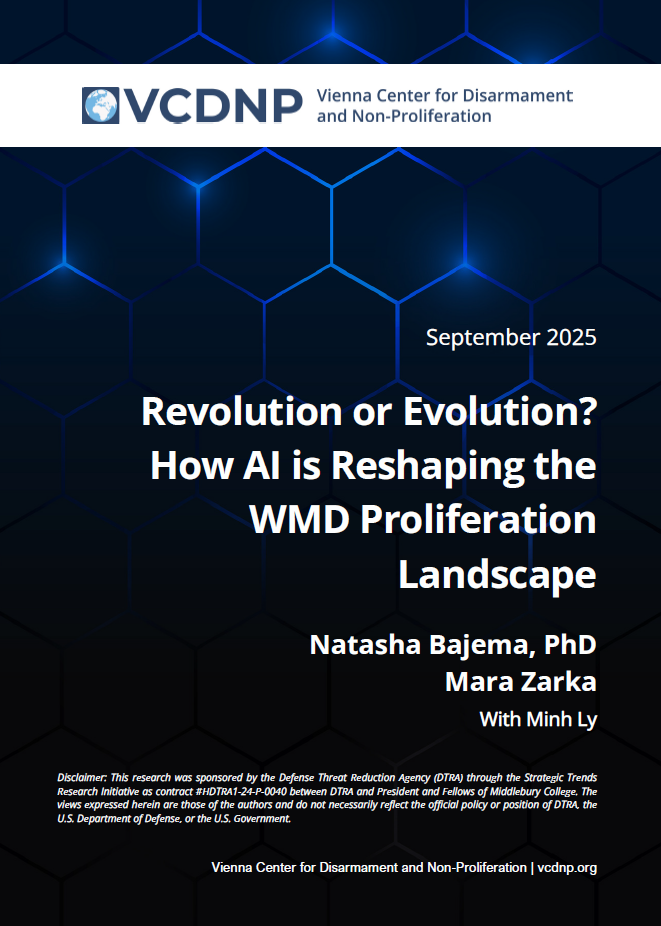
Artificial intelligence (AI) is transforming our day-to-day lives, from how we communicate to how we conduct business. Recent advances in AI have raised concerns among security experts globally about the implications for the proliferation of weapons of mass destruction(WMD). While nuclear, biological, and chemical weapons systems relied heavily on human expertise and physical materials and infrastructure in the past, advances in AI, especially in data analysis and automation, are altering the proliferation landscape. Could AI enable new pathways to WMD development? Under what circumstances might proliferators choose to deploy AI technologies in weapons development programmes?
The VCDNP paper authored by Dr. Natasha Bajema, Senior Research Associate at the James Martin Center for Nonproliferation Studies, and Mara Zarka, VCDNP Research Associate, examines the intersections between AI and WMD with a view to providing policymakers with astructured guide for thinking about this emerging threat space. The publication draws on a one-year technical study mapping potential risks at the AIWMD nexus over the next five to ten years.
The paper discusses three main points:
- Why would actors use AI to develop or use WMD?
- Highlights the distinction between proliferation capabilities and intent.
- Examines where AI is most likely to intersect with WMD development pathways and where barriers persist.
The paper concludes with an outlook on how the AI-WMD nexus could change over the next ten years and offers eight recommendations for policymakers, diplomats, and security professionals to consider when trying to mitigate future threats.
Bottomline: the AI-WMD nexus does not yet constitute a revolution, but the evolving threat space does require careful attention.
Disclaimer: This research was sponsored by the Defense Threat Reduction Agency (DTRA) through the Strategic Trends Research Initiative as contract #HDTRA1-24-P-0040 between DTRA and President and Fellows of Middlebury College. The views expressed herein are those of the authors and do not necessarily reflect the official policy or position of DTRA, the U.S. Department of Defense, or the U.S. Government.