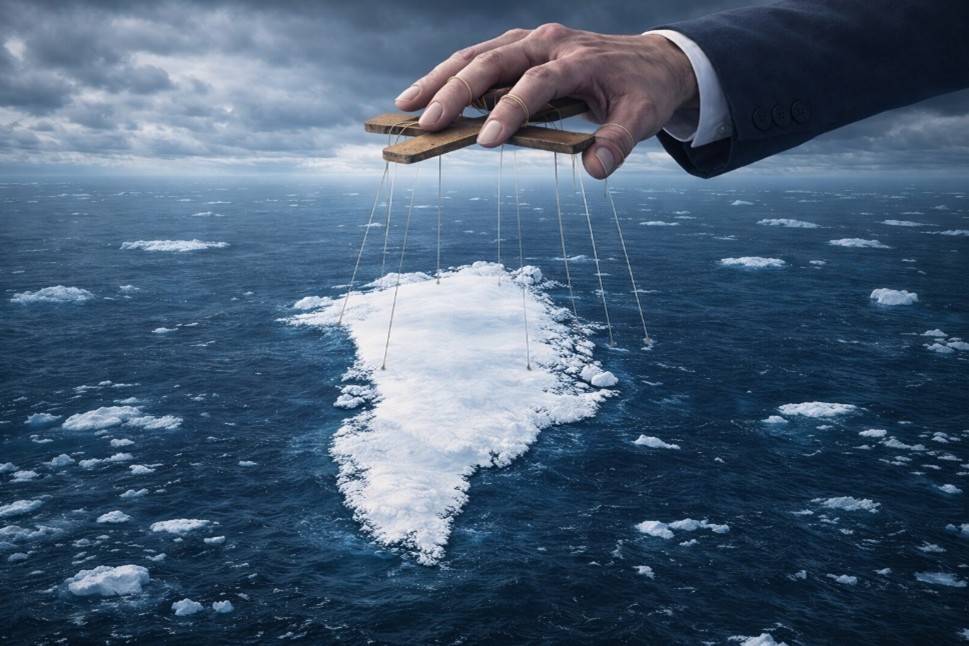
Greenland has always occupied a central place in American strategic thinking, as it lies in the shortest corridor between North America and Eurasia, it is a critical node for early warning and missile defence and a platform for space and Arctic operations and has an increasingly significant repository of critical minerals. At the beginning of 2026, President Trump’s intensified public calls for a US takeover or “ownership” of Greenland. From a European perspective, such statements were considered legally indefensible.
In a new commentary, Greenland, the United States and Arctic Security: Towards a credible and principled Transatlantic response, published by the European Leadership Network, VCDNP Senior Research Associate Federica Dall’Arche, together with other authors, reflects on the strategic considerations behind recent U.S. calls regarding Greenland and their broader implications for the Transatlantic Alliance and European security.
Assessing the European response to what the authors describe as a destabilizing U.S. claim concerning the territory of a European ally, the commentary notes that European leaders reacted in a united and firm manner. At the same time, the U.S. ambition highlights the need for a recalibrated EU approach to managing transatlantic disagreements. In particular, the authors argue that the EU must develop a clearer understanding of when a coordinated “pushback” may be necessary and how such a response can be effectively implemented.
“By reframing the issue from a bilateral Denmark-US dispute to a NATO matter of sovereignty and alliance principles, and by signalling potential trade and economic consequences, European capitals demonstrated solidarity.”
The authors also stressed how any discussion concerning Greenland’s territory or future that excludes Greenlanders themselves would be deeply problematic. Greenlandic voices must remain central and must not be marginalised in strategic debates about the island. As emphasised in Greenland’s 2024 foreign and Arctic policy, the principle “nothing about us, without us” should serve as a guiding framework for any international discussion on Greenland.
The commentary brings together a distinguished group of international scholars and policy experts, including Alexandra Filippenko, independent researcher; Gabriella Gricius, Postdoctoral Fellow at the University of Konstanz and Senior Fellow at the Arctic Institute as well as Fellow and Media Coordinator at the North American and Arctic Defence and Security Network,; Henrik Larsen, Non-Resident Fellow at the Center for European Policy Analysis (CEPA); and Nikita Gryazin, ELN Policy Fellow.