


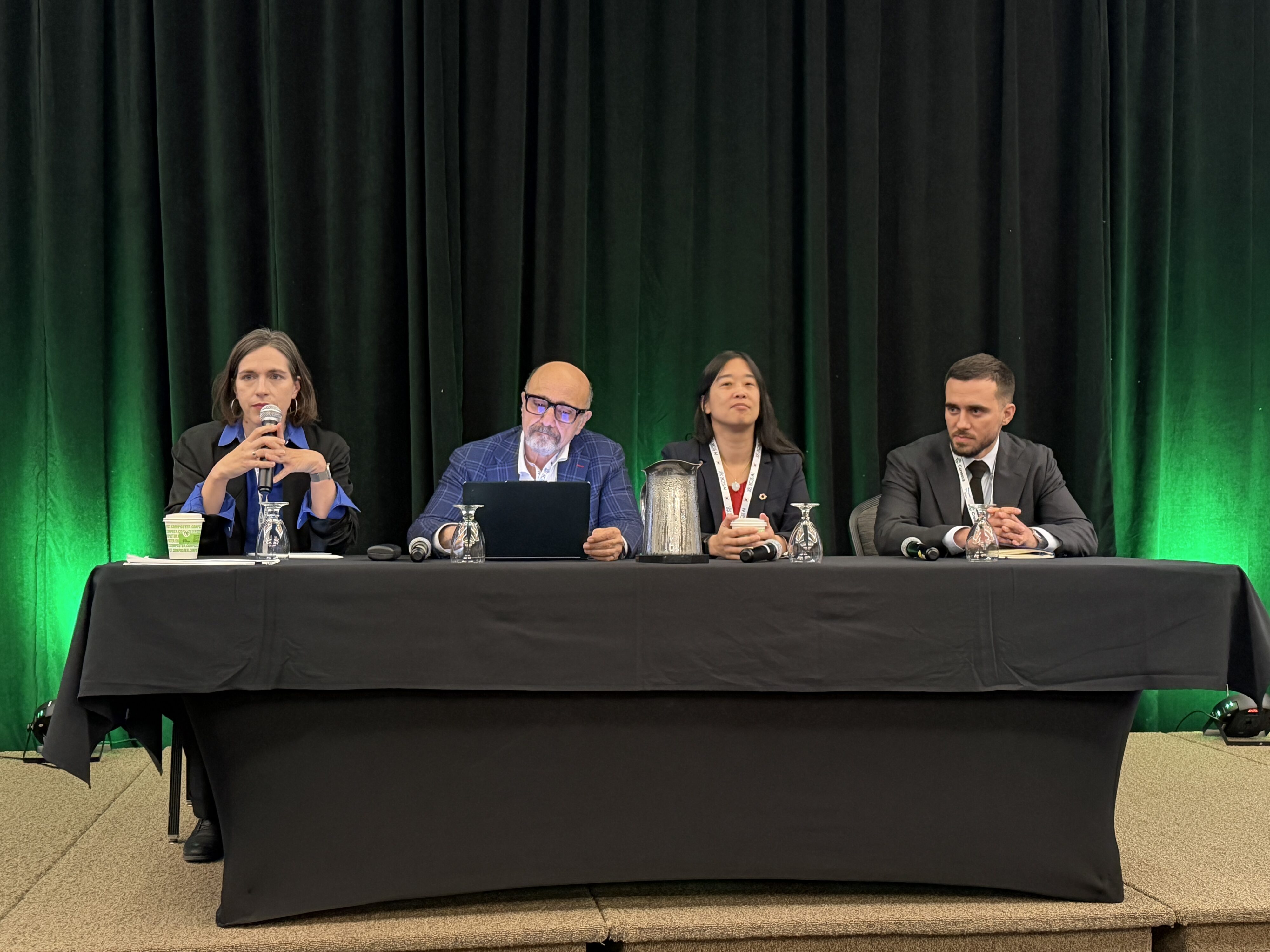
In October 2026, the Vienna Center for Disarmament and Non-Proliferation (VCDNP) took part in the Canadian Nuclear Society’s 2026 Conference on Disruptive, Innovative and Emerging Technologies (DIET) in Niagara Falls, Ontario. On the margins of the conference, the VCDNP convened a workshop to preview its forthcoming report on regulating AI and cybersecurity. The next day, Dr. Sarah Case Lackner, Director of the VCDNP Emerging Technologies Programme, moderated the conference’s opening plenary session on how emerging technologies are equipping malicious actors with new capabilities.
On 6 October 2026, the VCDNP hosted the workshop Nuclear Security in a Changing World: Managing Cybersecurity for Nuclear Security in the Age of AI. The workshop built on two earlier VCDNP workshops on regulation, cybersecurity and AI: one held alongside DIET 2025 and co-organised with the OECD Nuclear Energy Agency’s (NEA) RegLab process, and a brainstorming workshop in Vienna in June 2026. It brought together regulators, industry representatives, and experts to identify what could prevent the principles proposed in the VCDNP’s forthcoming report from working in practice, and how to address those barriers.
Dr. Case Lackner opened the workshop and joined Mr. David Smeatham of Ennuvo to review the outcomes of the 2025 workshop. Dr. Case Lackner then previewed a set of principles for a regulatory approach for the intersection of cybersecurity and AI, drawn from the VCDNP’s forthcoming report on the June 2026 brainstorming workshop. Ms. Kim Lawson-Jenkins, formerly of the US Nuclear Regulatory Commission, and Mr. Tom Kretzmer of Westinghouse further explained the context of the principles and how they emerged from the June discussions. A question-and-answer session followed. Although most participants felt the principles were right, how to implement them concretely in a national regulatory approach remained unresolved.
Dr. Case Lackner went on to lead participants in an exercise designed to examine the challenges likely to emerge if the principles were put into practice. A central tension was that measuring regulatory performance in a flexible way is hard to reconcile with operators’ need to know what they are being measured against, and the responsibility for defining what "good enough" looks like ultimately falls to the regulator. Participants also discussed the trade-off between specific guidance, which quickly becomes outdated, and very general guidance, which risks becoming meaningless. Informal information sharing posed another potential challenge, as operators may hesitate to discuss problems openly with regulators for fear of penalties.
By the close of the workshop, participants agreed that a useful next step would be to test and adapt the principles in a concrete use case, through a regulatory sandbox approach such as the NEA’s RegLab. One promising candidate that emerged from the discussions was using AI agents for defensive cybersecurity, which would require the kind of regulatory flexibility the report calls for.
On 7 October, Dr. Case Lackner moderated the opening plenary of DIET, a fireside chat with Dr. Ahab Abdel-Aziz (Gowling WLG Canada), Ms. Emma Wong (IonQ), and Mr. Redouane El Ghalbzouri (NEA). The discussion covered the lessons AI safety can draw from nuclear safety and security, how to keep AI cyber defence agents under control, post-quantum cryptography, the implications of quantum sensing for physical protection, and how regulators can keep pace with technological change.
The VCDNP expresses its sincere gratitude to all participants and contributors, reaffirming its dedication to fostering dialogue on the evolving challenges and opportunities at the intersection of nuclear security and emerging technologies.
The VCDNP extends its heartfelt appreciation to Global Affairs Canada for its generous support, which made this work possible.