Frontier AI and Nuclear Security: Evolving Risks and Mitigation Strategies
16 December 2025 •
Event
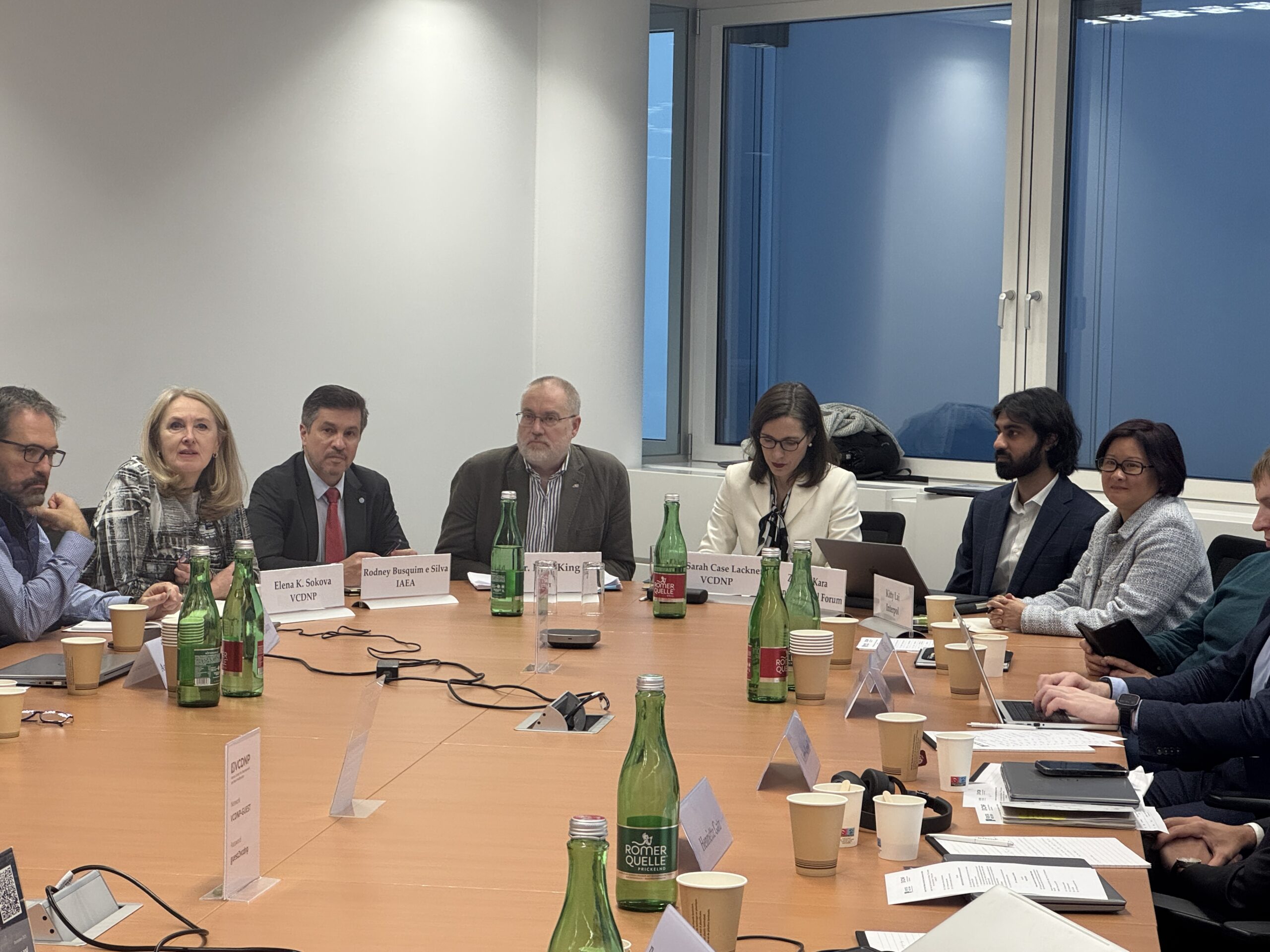
The VCDNP and the Frontier Model Forum held a panel discussion to discuss the evolving risks and mitigation strategies at the nexus of frontier AI and nuclear security.
Share this:
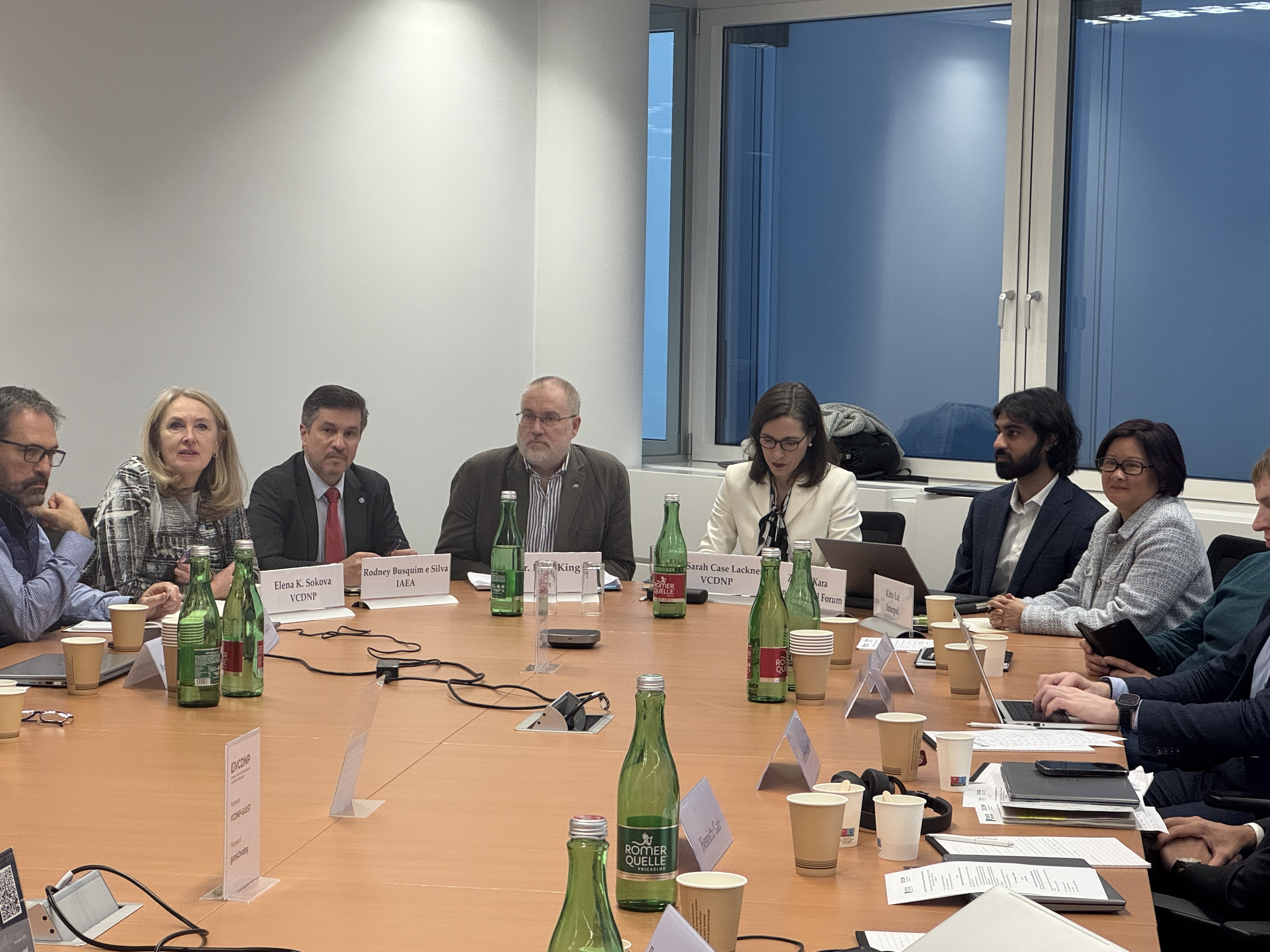
On 2 December 2025, the Vienna Center for Disarmament and Non-Proliferation (VCDNP) and the Frontier Model Forum (FMF) held a panel discussion on frontier AI models and nuclear security. The panel discussion followed a half-day meeting focused on the same topic. Both events were held under the Chatham House Rule.
Moderated by VCDNP Senior Fellow Dr. Sarah Case Lackner, the panel discussion was opened by VCDNP Executive Director Elena K. Sokova. The speakers featured in the panel discussion were:
Zaheed Kara, AI Safety Manager, Frontier Model Forum
Dr. Ross King, Head of Competence Unit Data Science & Artificial Intelligence, AIT - Austrian Institute of Technology
Kitty Lai, Criminal Intelligence Analyst, Radiological and Nuclear Terrorism Prevention Unit, CBRNE Sub-Directorate, INTERPOL General Secretariat
Rodney Busquim e Silva, Head of the Information Management Section, Division of Nuclear Security, International Atomic Energy Agency (IAEA)
To open the discussion, Ms. Sokova highlighted the latest VCDNP report on Artificial Intelligence and Nuclear Security Governance: Addressing the Risks of Frontier AI, authored by Dr. Sarah Case Lackner and Zaheed Kara. She noted the relevance of the topic and that the panel discussion was occurring on the eve of the first IAEA Symposium on Artificial Intelligence (AI) and Nuclear Energy.
The panellists covered several aspects of the frontier AI and nuclear security nexus, including:
Foreseeable advancements in frontier AI capabilities in the coming years that could be relevant to the security of nuclear materials and facilities
The importance of AI safety and how that relates to securing nuclear facilities and materials
Evolving concerns from the perspective of law enforcement in this new risk landscape
Key differentiators of the security of nuclear materials and facilities compared to other critical infrastructure
Some highlights from the discussion include:
Frontier AI can enhance malicious actors’ capabilities or even provide new capabilities to less sophisticated adversaries, as exemplified in the increase in cybercrime, which need to be considered when securing nuclear materials and facilities.
Future advancements in frontier AI cannot be accurately predicted. However, regardless of how technology evolves, the importance of pursuing regulations on how frontier AI is used in high-consequence critical infrastructure is important as well as ensuring that effective security measures are in place to defend against AI-enhanced threats.
The nuclear sector differs from other critical infrastructure in the amount of information publicly available that an AI might be able to assist a malicious actor in processing. In addition, another keyconcern in the nuclear sector is the impact of an attack against a nuclear facility on people, property, and the environment, and consequentially the resulting effect on public opinion around nuclear energy writ large.
AI systems can also be used by defenders to better protect against AI-enhanced threats.
During the question and answer session, panellists stressed the importance of engagement and dialogue among key stakeholders for addressing concerns surrounding frontier AI and nuclear security.Emphasis was placed on identifying common goals and the need for a common lexicon among all stakeholders to drive discussions. Panellists highlighted the importance of being able to backtrace steps in an AI model when something goes wrong, raising issues of reverse engineering AI outputs and reproducing model training. While it was emphasised that nuclear security remains a State’s responsibility, panellists underscored that international cooperation is required. One suggestion was to use State-led funding mechanisms to enforce regulations surrounding AI related to traceability, reproducibility, and explainability.
The VCDNP thanks FMF for its support and collaboration to make this event possible.
Registration & Questions
We kindly ask you to RSVP using our online registration. Should you have any questions, please e-mail or call us.
Resulting from a series of three workshops held between April 2019 to November 2020, the VCDNP compiled a recommendation paper on work that could be done in order to strengthen nuclear safeguards and export controls in managing new challenges posed by advanced nuclear and emerging technologies.
To provide the best experiences, we use technologies like cookies to store and/or access device information. Consenting to these technologies will allow us to process data such as browsing behavior or unique IDs on this site. Not consenting or withdrawing consent, may adversely affect certain features and functions.
Functional Always active
The technical storage or access is strictly necessary for the legitimate purpose of enabling the use of a specific service explicitly requested by the subscriber or user, or for the sole purpose of carrying out the transmission of a communication over an electronic communications network.
Preferences
The technical storage or access is necessary for the legitimate purpose of storing preferences that are not requested by the subscriber or user.
Statistics
The technical storage or access that is used exclusively for statistical purposes.The technical storage or access that is used exclusively for anonymous statistical purposes. Without a subpoena, voluntary compliance on the part of your Internet Service Provider, or additional records from a third party, information stored or retrieved for this purpose alone cannot usually be used to identify you.
Marketing
The technical storage or access is required to create user profiles to send advertising, or to track the user on a website or across several websites for similar marketing purposes.