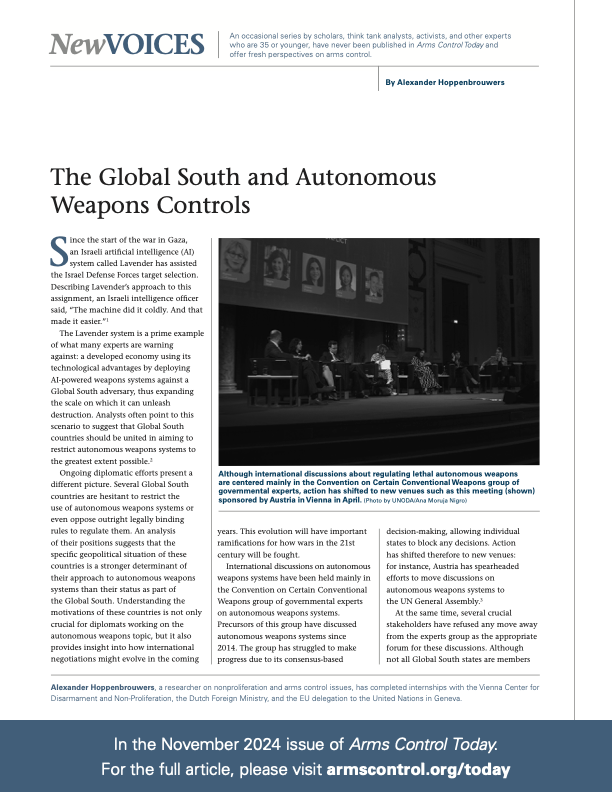
In a New Voices feature in the November 2024 issue of Arms Control Today, written during his time at the VCDNP, former Research Intern Alexander Hoppenbrouwers lays out how States in the Global South differ in their approach to autonomous weapons regulations, and what this may mean for the future of discussions on the topic.
Analysts often suggest that the Global North's technological edge over the Global South means that the latter should seek to restrict autonomous weapons as much as possible. While small States in the Global South indeed tend to argue for a strict, legally-binding instrument to regulate autonomous weapons, large States, such as China and India, are acquiring their own AI-enabled military systems.
Meanwhile, middle-sized States in the Global South that are confronted with armed violence at home or in their neighbourhood are generally less supportive of legal restrictions on autonomous weapons and more interested in using AI for military purposes. This diversity of interests has made it difficult for the majority of Global South States, who support legal restrictions, to advance their position, with groups like the Non-Aligned-Movement having limited ability to provide substantive input during discussions.
Mr. Hoppenbrouwers argues that cross-regional coalitions will therefore become increasingly important in global discussions on autonomous weapons. Recent efforts to move discussions from a group of governmental experts to the UN General Assembly could offer an opportunity for the Global South, which counts more members in the General Assembly than in the group of governmental experts. The General Assembly, unlike the experts group, also does not require consensus for all decisions.
At the same time, more Global South States may try to acquire autonomous weapons in the face of the deteriorating international security situation. Regional efforts in the Global South to commit States to far-reaching autonomous weapons restrictions could help unify parts of the Global South in their stance, and may help to prevent the proliferation of these weapons.
Alexander Hoppenbrouwers completed a Research Internship at the VCDNP between March and October 2024. Previously, he served as a trainee at the EU Delegation in Geneva and worked as an intern at the Security Policy Department of the Dutch Ministry of Foreign Affairs. He holds a Master’s degree in International Security with a specialisation in Diplomacy and Middle East Studies from Sciences Po Paris.