Prohibition of Military Attacks on Nuclear Facilities
12 September 2022 •
Commentary, Nuclear Security, Publications
VCDNP Non-Resident Senior Fellow John Carlson has written a new article discussing the prohibition of military attacks on nuclear facilities.
Share this:
The following is an excerpt of an article written by John Carlson, Non-Resident Senior Fellow, VCDNP. The full article was published on 12 September 2022. It is available below.
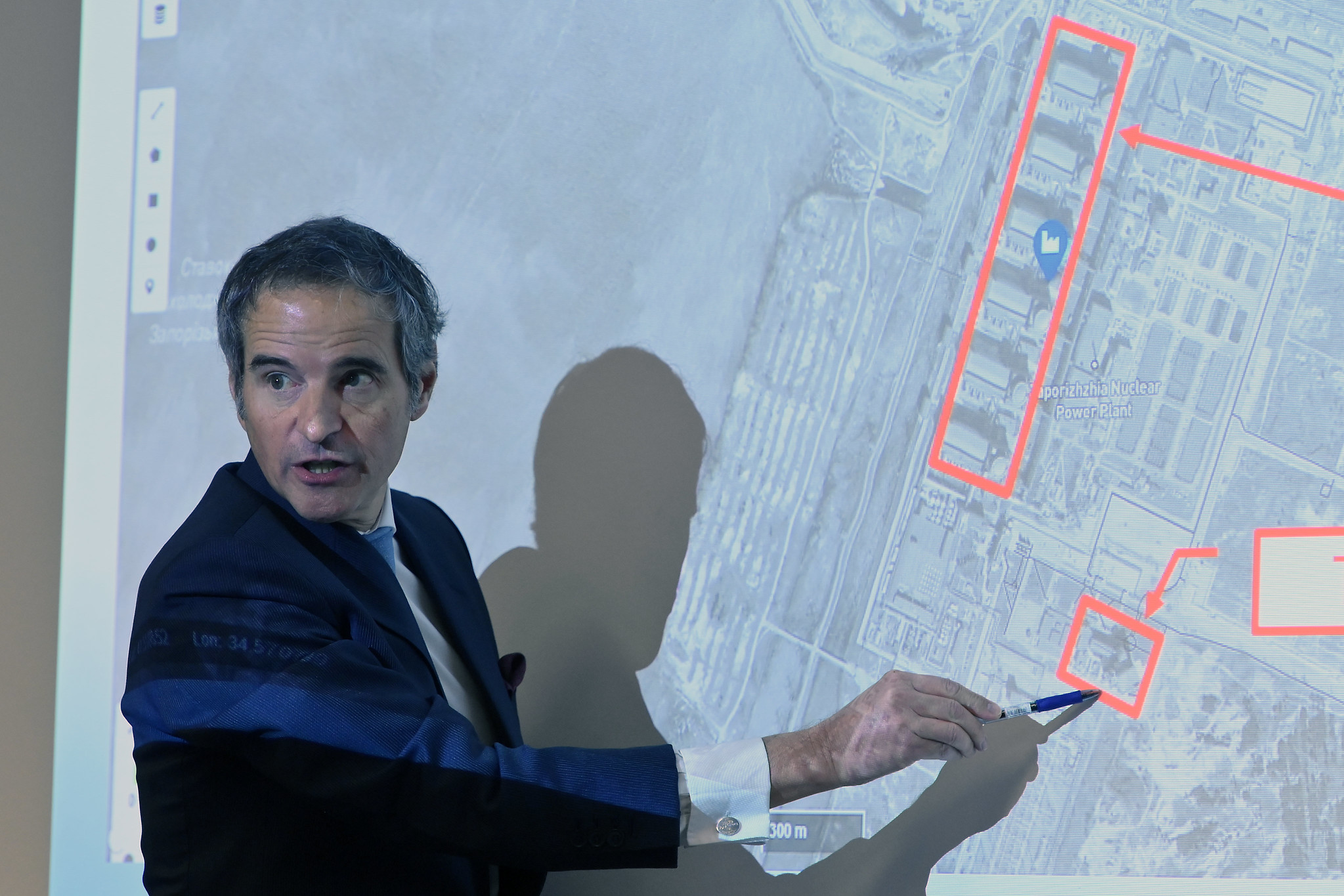
Rafael Grossi, Director General of the IAEA, talking about one of the earlier shellings of the Zaporizhzhia plant; Photo Credit: Dean Calma / IAEA
The war in Ukraine, particularly fighting around the Zaporizhzhya nuclear power plant, has drawn the world’s attention to the danger presented by military attacks on nuclear facilities. Such attacks could cause widespread radioactive contamination, affecting civilian populations not only in the state concerned but potentially well beyond that state. This danger highlights the need (a) for clear international legal rules prohibiting military attacks on or near nuclear facilities, and (b) for all states to observe such rules.
Prior to Zaporizhzhya there had been several attacks on nuclear facilities, in most cases before the facilities concerned had commenced operation. Fortunately none of these attacks resulted in significant radiation releases:
In 1980 Iranian aircraft attacked Iraq’s Osirak research reactor, then under construction, damaging ancillary buildings but not the reactor itself.
In 1981 Israeli aircraft destroyed the Osirak reactor.
From 1984 to 1987, during the Iran-Iraq war, Iraq launched several air strikes on Iran’s two Bushehr power reactors, then under construction, causing major damage.
In 1991 and 1993, during the First Gulf War, the United States attacked the Tuwaitha research centre and other nuclear targets in Iraq.
In 2007 Israeli aircraft destroyed Syria’s al-Kibar reactor. This was a plutonium production reactor supplied by North Korea and built in secret. At the time of the attack the reactor was close to start-up.
The most recent example involved a non-state actor – in July 2014 Hamas launched unsuccessful rocket attacks against Israel’s Dimona reactor.
Following the publication of the new US National Security Strategy (NSS) and Europe’s reaction to it, VCDNP Senior Research Associate Federica Dall’Arche in an article for Formiche examines the fracture in the transatlantic relations, arguing that it reflects a longer-term strategic shift rather than a sudden change.
How are the IAEA and Member States responding to the COVID crisis? How are safeguards practices maintained in the face of the pandemic? IAEA DG Grossi, Philippines Ambassador Natividad and UK Ambassador Hall answer these questions in the VCDNP's latest webinar, recording included.
To provide the best experiences, we use technologies like cookies to store and/or access device information. Consenting to these technologies will allow us to process data such as browsing behavior or unique IDs on this site. Not consenting or withdrawing consent, may adversely affect certain features and functions.
Functional Always active
The technical storage or access is strictly necessary for the legitimate purpose of enabling the use of a specific service explicitly requested by the subscriber or user, or for the sole purpose of carrying out the transmission of a communication over an electronic communications network.
Preferences
The technical storage or access is necessary for the legitimate purpose of storing preferences that are not requested by the subscriber or user.
Statistics
The technical storage or access that is used exclusively for statistical purposes.The technical storage or access that is used exclusively for anonymous statistical purposes. Without a subpoena, voluntary compliance on the part of your Internet Service Provider, or additional records from a third party, information stored or retrieved for this purpose alone cannot usually be used to identify you.
Marketing
The technical storage or access is required to create user profiles to send advertising, or to track the user on a website or across several websites for similar marketing purposes.