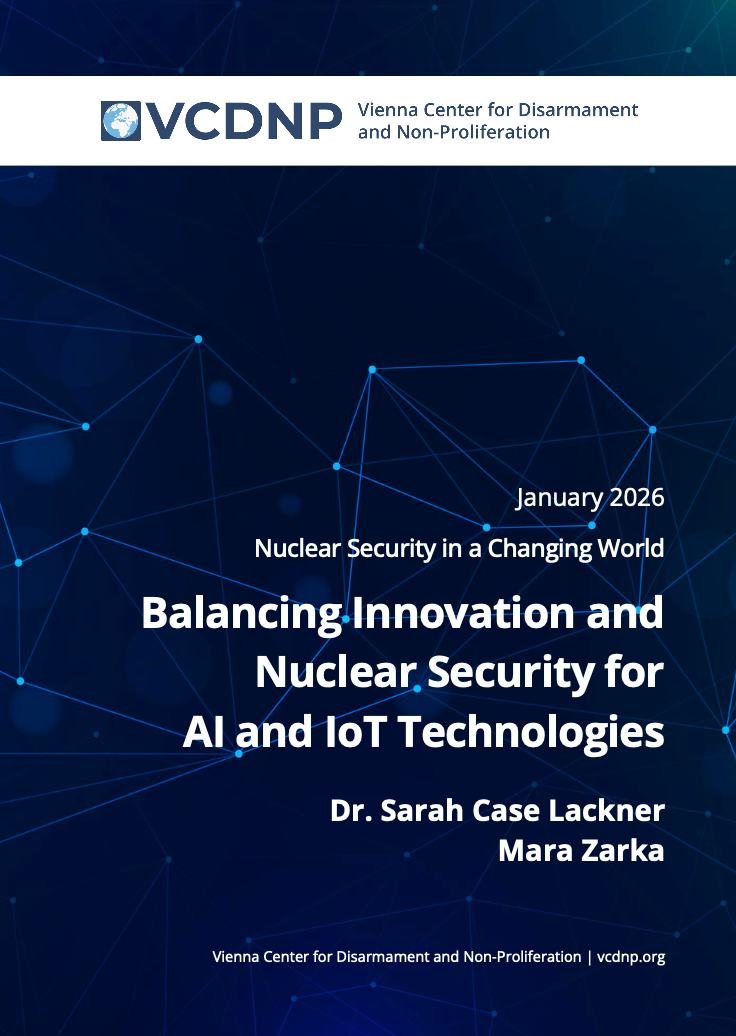
Balancing Innovation and Nuclear Security for AI and IoT Technologies

15 January 2026 • 
Publications, Reports and Papers
VCDNP experts Dr. Sarah Case Lackner and Mara Zarka address the intersection of the Internet of Things, AI, and nuclear security, providing policymakers with recommendations on how to best harness IIoT and AI while maintaining robust nuclear security in an increasingly digital world.
Share this:

Many everyday devices can connect to networks and exchange data, making them part of the Internet of Things (IoT). In industrial settings, these are known as the Industrial Internet of Things (IIoT). IIoT devices are increasingly paired with AI to automate processes and support human decision-making, with the goal of improving operational efficiency and performance. 

The nuclear industry, like other sectors, is increasingly considering adopting IIoT devices and AI to improve efficiency, reduce costs, and enhance security. However, greater reliance on these technologies in critical infrastructure, such as nuclear facilities, can also introduce new and expanded risks, particularly in cyber security and in vulnerabilities unique to AI systems. 

The expanding use of consumer IoT and publicly available AI also creates additional security challenges, as malicious actors can misuse these tools to carry out more sophisticated cyber attacks, social-engineering campaigns, and data manipulation. 

The latest VCDNP report by Senior Fellow Dr. Sarah Case Lackner and Research Associate Mara Zarka examines the nuclear-security risks posed by IoT and AI, how those risks can be addressed, while recognising the significant benefits these technologies may also provide. The report presents four broad recommendations for nuclear security policymakers, regulators, operators, and researchers: 

  1. In highly digitalised nuclear facilities using IIoT and AI, nuclear security, especially cyber security, should prioritise reliability and resilience over the unrealistic goal of preventing every attack. 
  1. Cost-benefit assessments for IIoT and AI integration should account for physical and cyber security measures needed to maintain robust nuclear security. 
  1. The nuclear sector should proactively learn from other critical infrastructure sectors that are advancing more rapidly in digitisation and in the use of IIoT and AI. 
  1. Up-to-date, practical guidance for operators and regulators on maintain nuclear security in a rapidly changing environment should be continuously developed and shared by international and other relevant organisations, including NGOs and industry groups. 

The report draws on insights and discussions from a workshop convened at the VCDNP on 15 and 16 October 2025 on this topic, and expert research. 

The VCDNP thanks Global Affairs Canada for their generous support of this project. 


Related Experts

Mara Zarka
Research Associate and Project Manager

Related Content

VCDNP Fact Sheet on the Sustainable Use of Radioactive Sources for Agriculture and Food Security

Ingrid Kirsten, VCDNP Senior Research Associate, has authored a new fact sheet on the sustainable uses of radioactive sources for agriculture and food security.
Read more

Conference Side Event: The A/CPPNM and Nuclear Security, A Conversation with U.S. Under Secretary of State Bonnie D. Jenkins

1 April 2022 • 
On 29 March 2022, the VCDNP hosted a hybrid side event at the Conference of the Parties to the Amendment to the Convention on the Physical Protection of Nuclear Material (A/CPPNM) with Ambassador Bonnie D. Jenkins.
Read more
1 2 3 63
cross
linkedin facebook pinterest youtube rss twitter instagram facebook-blank rss-blank linkedin-blank pinterest youtube twitter instagram