The expiration of the New START Treaty on 5 February 2026 marks the end of an era that began in 1969, when the United States and the Soviet Union launched the SALT I negotiations. For the first time in decades, there will be no treaty constraining the nuclear arms race.
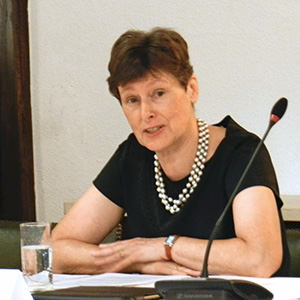
VCDNP Senior Fellow Dr. Nikolai Sokov analyses what will be lost with the passing of New START, as well as the proposal by Russian President Vladimir Putin to continue observing the Treaty’s quantitative and qualitative limits in the absence of a verification regime. That regime ended in the spring of 2023, when Russia suspended its participation in the Treaty. He concludes that although the arrangement proposed by Russia is largely symbolic, it is nonetheless desirable in light of the forthcoming NPT Review Conference.
He also outlines a new agenda: a new generation of arms control and, perhaps more urgently, a new generation of risk-reduction and confidence-building measures. Sokov argues that the latter task is politically more feasible because such measures, while going a long way towards preventing unintended military conflict, could be negotiated in an adverse political environment and thus pave the way for more comprehensive arms control agreements.
New START—the Treaty on Measures for the Further Reduction and Limitation of Strategic Offensive Arms—signed by the United States and Russia in 2010, expires on 5 February 2026. Its expiration will mark the end of an era of US-Soviet/Russian arms control that began in 1969 with the launch of SALT I negotiations, as well as decline of arms control more generally. Almost all bilateral and multilateral agreements on nuclear and conventional arms, except for few limited confidence building measures, have either expired or been abrogated.
This will not be the first time the United States and Russia find themselves without an arms control treaty. In previous cases, however, negotiations were under way and a successor agreement was in sight. Today, there are no negotiations—bilateral or multilateral—and none are even planned. Instead, nuclear weapon states, not limited to the United States and Russia, have entered a phase of qualitative and, to a lesser extent, quantitative arms race. In the absence of the last remaining nuclear arms control treaty, this competition may become increasingly destabilising.
New START cannot be extended: it permitted only one five-year extension, which was used in 2021. Keeping the treaty alive would likely require re-ratification, but the prospects for securing the necessary two-thirds majority in the US Senate are low (ratification by Russia’s Federal Assembly would be significantly more likely).
Another option would be an informal agreement to abide by the terms of the expired treaty. There is precedent for such an arrangement. In 1981, the United States and the Soviet Union agreed to abide by the unratified 1979 SALT II Treaty, which helped preserve a degree of strategic stability while the parties negotiated START I, signed in 1991. In September 2025, President Vladimir Putin announced that Russia would continue to adhere to New START’s quantitative and qualitative limits for one year after its expiration and invited the United States to do the same, with the possibility of extension. US President Donald Trump described the idea as ‘good’, but at the time of writing the United States has issued no official response. Subsequently, Donald Trump remarked that ‘if it expires, it expires’ and promised a ‘better agreement’, without providing specifics.
What Is New START and the Consequences of Its Expiration
The consequences of New START’s expiration must be understood in a broader context: the treaty’s purpose and scope, the factors likely to affect strategic balance in the coming years, and the prospects for resuming arms control in the foreseeable future.
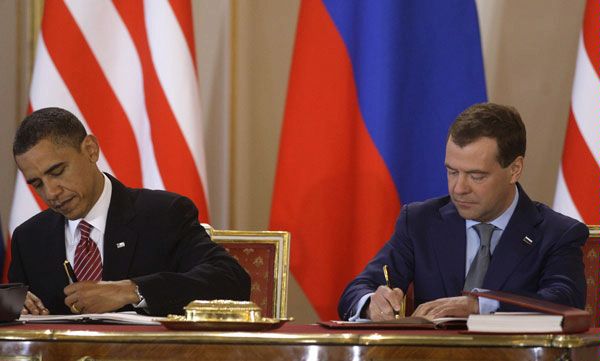
New START was negotiated in relative haste as a temporary remedy to the loss of transparency and predictability of the strategic balance with the expiration of START I in December 2009. This effort could not take place earlier because the George W. Bush administration showed no interest in arms control, and Barack Obama, who became president in 2009, together with Russia had to take urgent measures. Negotiations began in the summer of 2009 and concluded in record time: the treaty was signed in spring 2010 and entered into force in early 2011.
Time constraints shaped the treaty’s limited scope. New START focused on restoring verification, data exchange, and confidence-building mechanisms, while imposing only modest substantive limits. The reductions themselves were largely symbolic: from 2,200 accountable warheads under the 2002 SORT Treaty (in practice, even fewer) to 1,550. More ambitious and controversial issues were deliberately deferred to future negotiations to avoid delays.
In essence, New START was designed to stabilize the strategic relationship while the United States and Russia negotiated a more comprehensive follow-on agreement. As is now evident, such negotiations never materialised. The so-called ‘strategic stability dialogue’ fell far short of genuine negotiations: one or two brief high-level meetings per year were insufficient to produce results. Although working groups established in 2020 and late 2021 showed promise, they did not operate long enough. Consequently, New START unexpectedly became the cornerstone of arms control—a role it was never meant to play.
In spring 2023, Russia suspended its participation in New START. The United States rejected the legality of this step, noting that suspension is not provided for in the treaty text. Russia, however, justified its action under Article 72 of the Vienna Convention on the Law of Treaties, which permits suspension unless explicitly prohibited. Under the Convention, suspension may occur at any time and does not require justification.
In practical terms, suspension means that Russia remains bound by New START’s quantitative and qualitative limits but is no longer obligated to implement the treaty’s operational measures, including inspections and data exchanges (under the Vienna Convention, the party that suspends a treaty must be in a position to return to full compliance any moment). As a result, the treaty has lost much of its original purpose. While numerical limits still provide some transparency, the more critical element—the verification regime—has been frozen.
Vladimir Putin’s Proposal: What It Can and Cannot Achieve
Vladimir Putin’s autumn 2025 proposal to informally adhere to New START’s quantitative and qualitative limits effectively continues the treaty’s suspended state. The likelihood that Russia would agree—even informally—to restore the verification regime is very low, and any counterproposal along those lines would almost certainly be rejected. Moreover, verification cannot be restored by a US executive decision and would likely require approval by the US Congress, as it must be funded through the federal budget.
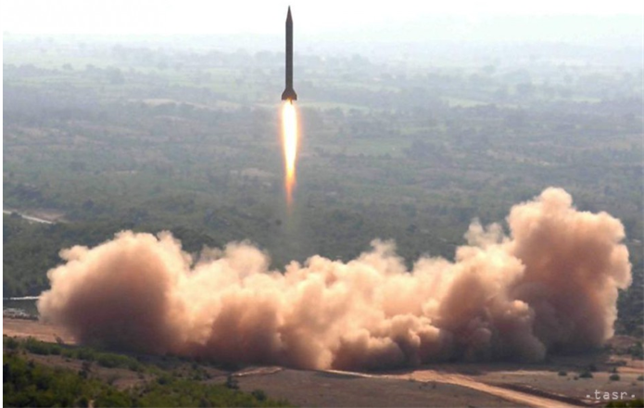
The arrangement proposed by Putin would therefore be largely symbolic. Both sides are already planning or implementing programmes that will eventually alter the strategic balance. The United States may expand its strategic forces in response to China, while Russia continues testing systems not covered by New START, such as the Burevestnik nuclear-powered cruise missile and the Poseidon nuclear-powered torpedo. At the same time, strategic balance is highly resilient, and these and other programmes will not have a tangible impact for several years. In this context, Putin’s proposal could still provide a modest—though very small—degree of predictability over the next two to five years.
Adherence to New START’s limits could have a more meaningful political effect in the context of the nuclear non-proliferation regime. For years, non-nuclear-weapon states have increasingly criticised nuclear-armed states for failing to implement Article VI of the NPT, which obliges them to pursue nuclear disarmament. The expiration of New START only months before the NPT Review Conference, beginning on 27 April in New York, will likely intensify these concerns. A joint US-Russian announcement committing to observe at least some elements of the expired treaty—especially if paired with a pledge to resume negotiations—could help somewhat mitigate the looming crisis.
Summary
Future Negotiations
In a way, New START was bound to conclude a long series of treaties negotiated over more than five decades; from the start, it was supposed to pave way for a new-generation treaty, which, unfortunately, never happened. It reflected a traditional arms control agenda focused on delivery vehicles and the total number of warheads that could be delivered in first strike; it addressed nuclear weapons separately from conventional military capabilities. These principles were acceptable for a “placeholder” treaty, but do not fit the new international security environment. Future arms control efforts will need to address a much broader range of issues, potentially including:
The last three elements reflect the Russian ‘security equation’ approach articulated during New START ratification in 2011. Addressing them will require trade-offs, including mutual accommodation of US, Russian, and Chinese priorities.
The challenges are formidable. Multilateral arms control has not been practiced since the 1922 Washington Naval Treaty; nuclear stockpiles, long-range conventional weapons, and space weapons have never been regulated or subject to verification. A single comprehensive treaty is therefore unrealistic. More likely, progress would take the form of multiple, interconnected agreements with differing legal status. Negotiating such an agenda will require considerable time, even under favourable conditions.
Given today’s unstable international environment and the increased risk of escalation, which is perhaps as high as during the worst days of the Cold War, a more immediate and achievable objective may be the negotiation of new risk-reduction and confidence-building measures (CBM). The legacy risk reduction and CBM regimes negotiated during the Cold War still work, but are insufficient to address the challenges of the present day.
The first order task is reliable and secure communication links, which are particularly valuable during crises. Today, only Washington and Moscow maintain a communication link that meets present-day requirements; similar links must connect London and Paris – perhaps also Brussels – with Moscow as well as, preferably, Beijing. These are particularly vital given elevated risk of conflict in Europe.
Cold War–era confidence-building measures, such as advance missile launch notifications, remain useful but are no longer sufficient. Expanding these measures—for example, by notifying concentration of long-range conventional strike assets and associated platforms, which could be mistaken for preparation for a pre-emptive strike—could reduce the risk of misinterpretation and inadvertent escalation.
For negotiations, risk-reduction and CBM regimes have an advantage over arms control: they do not require changes in force posture and are therefore less controversial. History shows they can be negotiated even in hostile political climates: major progress on CBMs was achieved as in the early 1980s, which was perhaps one of the most dangerous periods of the Cold War. Progress in this area could help lay the groundwork for renewed arms control.
Such negotiations are unlikely while the war in Ukraine continues (relevant attempts within the P-5 format have so far been unsuccessful due to Russian and Chinese reluctance), but the environment could change if efforts to end the conflict succeed. Russia’s long-standing engagement with risk reduction and confidence-building measures suggests it could re-engage. China may be more difficult to involve, as it conflates risk reduction with policy change, but this challenge is not unprecedented. In the early 1970s, the Soviet Union adhered to the same approach, but the Nixon Administration succeeded in combining broad policy principles with technical measures, and that arrangement worked well. Perhaps a similar approach could work for China.
The expiration of New START without even a distant prospect of a successor treaty is deeply regrettable. For more than half a century, the international system has relied on at least some mechanisms to constrain arms racing and, since the end of the Cold War, to reduce nuclear arsenals. That framework is now eroding, and a renewed arms race—potentially including nuclear forces—appears increasingly likely. Yet this moment should prompt not resignation, but renewed effort: to articulate a new arms control agenda, to rebuild political and public support, and to recognise that stability and peace require sustained, deliberate work. Hopefully, the loss of arms control will help to alert us to its value.