A Long and Tiresome Journey: A Negotiating History of the Composition of the IAEA Board of Governors

4 September 2026 • 
Non-Proliferation, Nuclear Safeguards, Nuclear Security, Peaceful Uses, Reports and Papers
A study by Senior Research Associate and Programmes and Outreach Manager Noah Mayhew traces seven decades of negotiations on the composition of the IAEA Board of Governors, drawing on extensive archival research.
Share this:
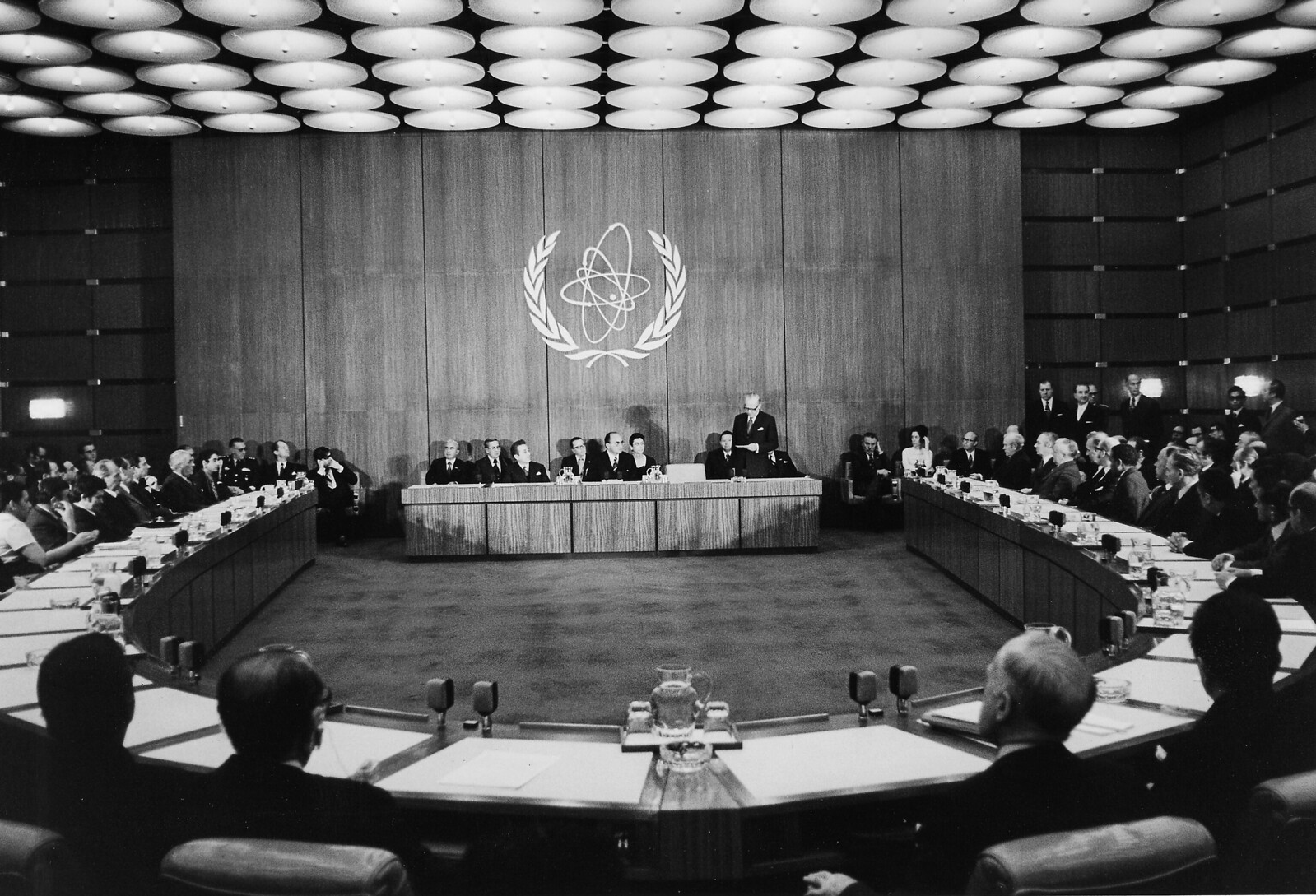
IAEA Director General Dr. Sigvard Eklund welcomes President Echeverria and his suite in the Board of Governors Room. Vienna, Austria. 12 February 1974. Credit: IAEA.

The International Atomic Energy Agency (IAEA) has had two policymaking organs since its founding: the General Conference, where all Member States sit, and the Board of Governors, a smaller body. The Board has grown over the IAEA’s history, from 23 Members to 35 today.

Member States have debated equitable representation on the Board since before the Agency was even founded, especially by developing countries. Three of the questions that run through that debate are: how many seats should be allocated to each regional/area grouping, which seats the Board designates and which the General Conference elects, and what criteria qualify a State for a seat.

A newer question has emerged more recently. Some Member States do not belong to any area group, which the Statute requires for Board membership. As of September 2026, 12 Member States are in this position, referred to as “arealess”.

Senior Research Associate and the VCDNP’s Programmes and Outreach Manager Noah Mayhew has authored a new study tracing these debates from 1955 to today. The study, entitled “A Long and Tiresome Journey: A Negotiating History of the Composition of the IAEA Board of Governors”, draws on extensive archival research, including documents from the IAEA Archives.

The study covers:

  • The 12-Nation Working-Level Meeting and the Conference on the Statute, which set the Board’s original composition in 1955 and 1956;
  • The first expansion of the Board, negotiated between 1960 and 1961 and in force by 1963;
  • The second expansion, negotiated between 1968 and 1970 and in force by 1973;
  • A long stretch of negotiations between 1977 and 1999, which produced one amendment on designated seats that took effect in 1990, and a second amendment that, as of 2026, still has not entered into force; and
  • The stalled debate since 1999, as IAEA membership has kept growing with no further expansion of the Board.

The author thanks the Andrew Carnegie Foundation for its generous support of this research.


Related Experts

Noah Mayhew
Senior Research Associate and Programmes and Outreach Manager

Related Content

What’s Next for the AUKUS Submarine Deal?

Following the AUKUS countries’ announcement of their intention to move forward with the provision of nuclear powered submarines to Australia, Research Associate Noah Mayhew published his analysis in the Bulletin of the Atomic Scientists.
Read more

Expanding Non-Power Peaceful Use Applications of Nuclear Science and Technology to Create an Enabling Environment for Nuclear Power

VCDNP Senior Research Associates Anthony Stott and Ingrid Kirsten co-authored a paper on the peaceful uses of nuclear science and technology in developing countries.
Read more
1 2 3 56
cross
linkedin facebook pinterest youtube rss twitter instagram facebook-blank rss-blank linkedin-blank pinterest youtube twitter instagram